

Meet Our Postdoctoral Fellows
Simon Baumann, PhD
Appointment: Rauschecker Lab
Office: New Research Building, WP-19B
Rita Chen, PhD
Appointment: Evans Lab
Office: New Research Building, EG-20
Maria Czarnecka, PhD
Appointment: Striem-Amit Lab
Office: New Research Building, WP-09
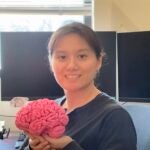
Lillian Chang, PhD
Appointment: Riesenhuber Lab (MAXLAB)
Office: New Research Building, WP-05
Lillian earned her PhD in Neuroscience at Georgetown University. Under the mentorship of Dr. Maximilian Riesenhuber, her dissertation research investigated the cross-modal interactions between the neural systems underlying language and speech during reading, spoken language, and visual speech processing.
After defending her dissertation in 2024, she accepted a position in Dr. Riesenhuber’s lab as the Postdoctoral Fellow on a challenging new research project in collaboration with Dr. Peter Bandettini at the NIH, examining the neural mechanisms of deep multi-modal concept learning in the brain. Using advanced neuroimaging techniques from both EEG recordings conducted at Georgetown and fMRI data collected from the NIH, this project investigates the neural dynamics underlying transfer of category representations at all time points: before, after, and – uniquely – during category learning. As the project makes headway, she has presented their findings at Society for Neuroscience and the Cognitive Computational Neuroscience research conferences.
Outside her work in MAXLAB, she enjoys finding fun things to print at Georgetown’s MakerHub. If you have your anatomical MRI scan, ask her how you can get a 3D print of your own brain!
Zhiqing Deng, PhD
Appointment: Striem-Amit Lab
Office: New Research Building, WP-09
Neeraj Kumar, PhD
Appointment: Orpella Lab
Office: New Research Building, WP-23
Neeraj Kumar earned his PhD in Cognitive and Computational Neuroscience from the National Brain Research Centre. His research has focused on human auditory processing using electrophysiology, multimodal neuroimaging, neural signal processing, brain stimulation, and computational modeling.
Currently, Neeraj is a Postdoctoral Fellow in the laboratory of Joan Orpella, where his work explores the network-level representation of speech processing and the functional brain networks involved in speech production. His research is particularly centered on the computational role of neural oscillations and how they support the sequencing, planning, and execution of cognitive processes that enable fluent speech production.
Outside the lab, Neeraj enjoys reading about history, philosophy, and emerging technologies.
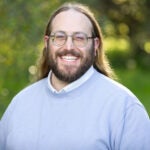
Brennan Gonering, PhD
Appointment: Ullman Lab & Reifegerste Lab (co-mentors)
Office: New Research Building, EP07
Brennan is a Postdoctoral Fellow in the Brain and Language lab of Drs. Michael Ullman and Jana Reifegerste. They received their PhD in linguistics from the University of California, Davis, working under Dr. David Corina. Their doctoral research combined behavioral, neuroimaging, and computational modeling methods to examine the relationship between long-term memory and learning the syntactic patterns of a new language.
Brennan’s current work looks at how word comprehension changes with age and the neuroanatomical, cognitive, and genetic variations that mediate these changes. This work complements their broader interest in understanding the mechanisms and dialectical forces underlying language. Their work is supported by the NIH Neuroscience of Language training grant.
Outside of the lab, Brennan enjoys traveling, spending time with their wife and cats, and getting involved in activism.

Valerie Lewitus, PhD
Appointment: Evans Lab
Office: New Research Building, EG-19
Valerie Lewitus is a Postdoctoral Fellow in the laboratory of Dr. Rebekah Evans at Georgetown University Medical Center. She earned her MS in Biology in 2018 and PhD in Neuroscience in 2023 from George Mason University.
For her doctoral research under Kim Blackwell, Valerie used electrophysiological techniques in mice to examine how reproductive cycles and ovarian hormones influence synaptic plasticity in the dorsal striatum, a brain region involved in motor skill learning.
In the Evans Lab, her research investigates the interconnected neural circuitry among the pedunculopontine nucleus, dorsal striatum, and substantia nigra pars compacta—three brain regions critical for motor control. Using a combination of electrophysiology, behavioral analysis, optogenetics, chemogenetics, and cellular imaging techniques, she studies how aerobic exercise enhances motor coordination and the neuronal mechanisms underlying these effects. She is also exploring how Parkinson ’s-like cholinopathy impacts these neural circuits.
Outside of research, Valerie enjoys watching movies, reading science fiction novels, and playing the viola.
Chantal Oderbolz, PhD
Appointment: Orpella Lab
Office: New Research Building, WP-23
Chantal earned a Master of Science in Psychology and a PhD in Linguistics from the University of Zürich under the supervision of Martin Meyer. Her doctoral research focused on speech perception in the brain, using EEG, MEG, and behavioral methods to investigate how prosody shapes neural representations of speech.
Currently, Chantal is a Postdoctoral Fellow in Dr. Joan Orpella’s lab, where she studies speech perception and production. Her work explores neural integration and the relationship between brain activity and behavior, and investigating the neural basis of stuttering. Her research is supported by funding from the Swiss National Science Foundation.
Outside the lab, Chantal enjoys playing electric guitar, spending time outdoors, and sharing a good neuroscience meme.
Harshul Pandit, PhD
Appointment: Rebeck Lab
Office: New Research Building, WP-26
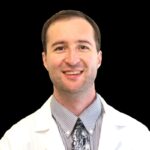
Max Stevenson, PhD
Appointment: Rebeck Lab
Office: New Research Building, WP-26
Max earned his B.A. in Cognitive Science from the University of Virginia before joining the Interdisciplinary Program in Neuroscience at Georgetown University to pursue his PhD. His dissertation research in the Laboratory for Dementia and Parkinsonism under Charbel Moussa examined the potential of novel small-molecule tyrosine kinase inhibitors to reduce neurodegenerative disease pathology.
Following graduation, Max joined the labs of Mark Burns and Patrick Forcelli as a Postdoctoral Fellow, where he investigates senescent brain cells following traumatic brain injury and their potential role in post-traumatic epilepsy. He is currently a trainee in the Aging and Alzheimer’s Research Training (AART) T32 Program.
Outside the lab, Max enjoys outdoor activities including baseball, rock climbing, and skiing, and exploring the DMV’s restaurants, music venues, and hiking trails.
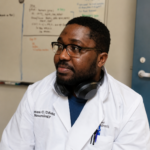
Kenea Udobi, PhD
Appointment: Evans Lab
Office: New Research Building, EG-20
Kenea Udobi is a Postdoctoral Fellow in the Evans Lab whose research focuses on neurodegenerative disease, memory mechanisms, and brain energy deficiencies. With a background in biological sciences, particularly cell and molecular biology, his work aims to better understand the mechanisms underlying neurological disorders.
Currently, Kenea studies Parkinson’s disease cholinopathy, with a focus on the selective degeneration of pedunculopontine nucleus (PPN) cholinergic neurons and how these changes influence the progression of Parkinson’s disease symptoms. His research seeks to identify mechanisms that may contribute to improved diagnosis and treatment of neurodegenerative disorders.
Originally from Nigeria, Kenea is passionate about improving healthcare access and hopes to apply his research toward practical solutions that positively impact underserved communities. Outside the lab, he enjoys reading science fiction and fantasy novels, swimming, and hiking.